
Applying SMART Goals
The Level Up! Arena Way
Quest Briefing (TL;DR for the Impatient Heroes)
- SMART goals work best when they’re short-term, personal, and tied to real behavior, not vague motivation.
- Before writing a SMART goal, break your thinking into three parts:
- Outcome Goal: Where you want to end up long-term
- Process Goal: The daily and weekly behaviors that move you forward
- Performance Goals: The milestones that tell you the system is working
- Once those are clear, writing a SMART goal becomes straightforward:
- Specific: Define exactly what success looks like
- Measurable: Decide how progress will be tracked
- Achievable: Challenge yourself without ignoring reality
- Relevant: Tie the goal to something that actually matters to you
- Time-Bound: Set a clear deadline to create urgency
- In Project Legacy, this approach turns a big, intimidating health goal into a six-month, actionable plan that prioritizes consistency, recovery, and sustainability over extremes.
Let’s Talk About SMART Goals
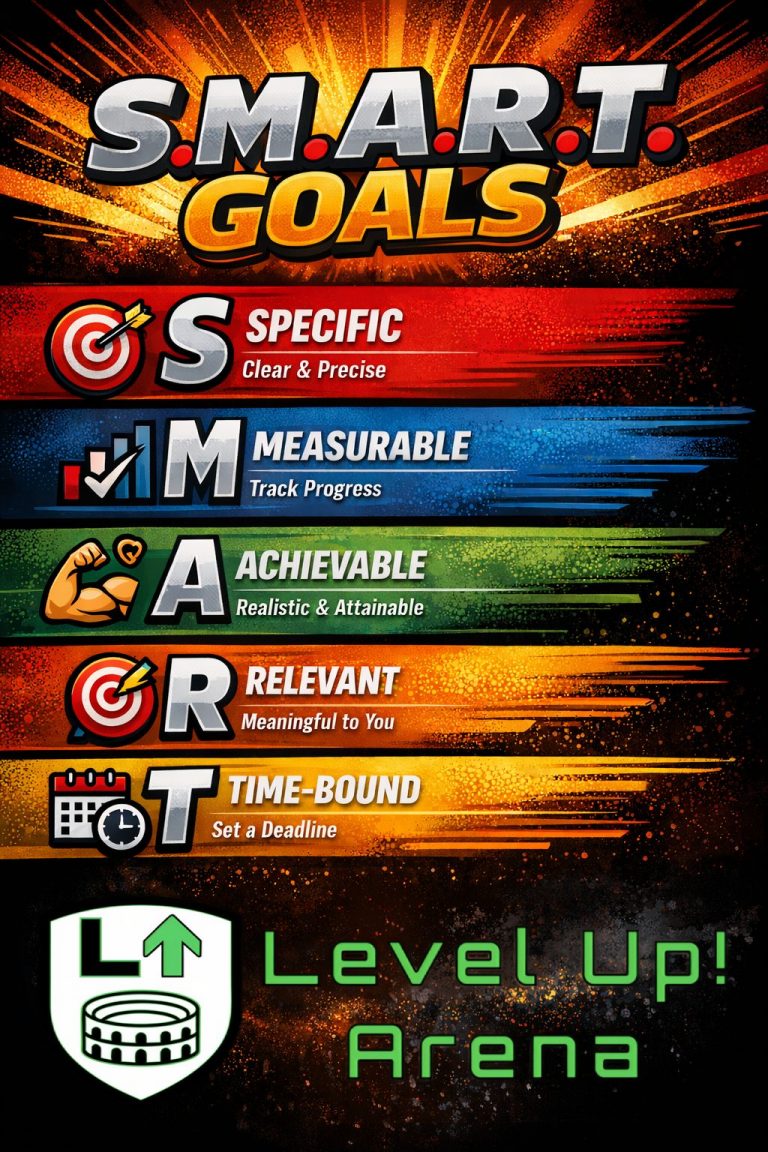
SMART goals are a powerful framework for creating goals that actually stick. The acronym stands for Specific, Measurable, Achievable, Relevant, and Time-bound. When used correctly, SMART goals can do wonders, especially in the health and fitness world (they work just as well for business and personal goals, but we’ll stay focused on fitness here). Not every goal works with SMART as not all goals need to be specific, however for health and fitness, a SMART Goal can be the difference between success and failure.
It’s generally agreed that SMART goals work best over shorter durations. A ten-year SMART goal is simply too abstract to drive daily action. Even a full year can feel too distant. For my own fitness journey, I break my goals into six-month SMART cycles. In this article, we’ll focus on the first six months. I already have a framework for future cycles, but those details stay intentionally blank until this first phase is complete.
Before we put this into action, let’s break SMART down a little further.
Specific
Goals need to be clear and precise. You should be able to describe exactly what success looks like without ambiguity.
Measurable
You need a way to track progress. This might be a 5K finish time, a deadlift number, changes on the scale, or even adherence to a training plan.
Achievable
Your goal should challenge you, but if you follow the plan, it should be realistically attainable.
Relevant
The goal needs to matter to you. If you pick something because it worked for someone else, your motivation will fade quickly. Relevance fuels consistency.
Time-Bound
This is the true engine of SMART goals. Deadlines create urgency. Without a timeframe, goals turn into “someday.”
Before SMART: Outcome, Process, and Performance Goals
If you’ve ever stared at a SMART goal template and frozen, you’re not alone, I’ve done the same. That’s why I recommend adding one step before writing a SMART goal.
The National Academy of Sports Medicine (NASM) recommends breaking goals into Outcome, Process, and Performance goals. I’ve found this approach incredibly helpful, especially for people who feel overwhelmed by goal-setting.
Here’s what that looks like:
Outcome Goal
The long-term destination. Think big at first. We’ll refine it later.
Process Goal
The behaviors required to make the outcome happen. This should be detailed but flexible. Life happens—you want a system that bends, not breaks.
Performance Goals
The milestones along the way. These tell you whether you’re moving in the right direction.

Putting This Into Action: Project Legacy

As part of Project Legacy at The Level Up! Arena, I’m putting my entire fitness journey on display. That makes this the perfect opportunity to show how these concepts work in real life, not theory.
To keep things manageable, I split my goals into two categories: Fitness and Health. I highly recommend splitting your goals into however many categories you need to laser focus on what you are really looking to achieve.
Outcome Goals
Fitness Outcome Goal
Years ago, I created a massive endurance bucket list, something I plan to pursue over the next 10–12 years. It includes Spartan Race weekends, marathons, Ironman events, and ultimately Badwater 135. If you’re not familiar with Badwater, it’s one of the most brutal endurance races on the planet: 135 miles from Death Valley (282 feet below sea level) to Whitney Portal (8,360 feet above sea level).
Health Outcome Goal
My long-term health goal is to lose excess fat and reach 165 pounds at 10–12% body fat, while maintaining strength, mobility, and flexibility. The real reason matters more than the numbers; I want to stay active, pain-free, and capable as my godson grows up. Writing that down flips a switch in my brain. This isn’t about vanity. It’s about longevity and presence.

Process Goals: Building the Engine

If the outcome is the North Star, the process is the engine.
Fitness Process Goal
Nutrition
I start by setting macros and adjusting them as needed. My initial split is 20% protein, 50% carbs, and 30% fat, allowing me to gradually increase protein intake. Over time, protein and fat percentages will swap as my training demands evolve.
Movement
You don’t run 135 miles through the desert without putting in the reps. My current plan includes five training days and two active recovery days per week. One day focuses on endurance; the remaining four blend strength, cardio, and high-intensity work.
Recovery
Recovery is non-negotiable. Without it, the engine fails. Sleep—especially after endurance sessions—is critical. Meditation, yoga, and time in nature all play a role. Sometimes recovery means not tracking anything and simply being present.
Health Process Goal
My health and fitness process goals are fully aligned, so everything above applies here as well.
Performance Goals: The Checkpoints
Fitness Performance Goal
This part is straightforward. I already have my endurance milestones mapped out. Timing will vary based on race schedules and travel, so flexibility is built in, but the order follows logical progression:
- Spartan Trifecta Weekend (5K, 10K, 21K over two days)
- Spartan Ultra (30+ miles)
- Marathon
- Tough Mudder Infinity (8-hour multi-lap OCR)
- Ultramarathon (50+ miles)
- Ironman Triathlon (2.4-mile swim, 112-mile bike, 26.2-mile run)
- World’s Toughest Mudder (24-hour OCR)
- Ultramarathon (100+ miles – Badwater qualifier)
Health Performance Goal
Health performance goals aren’t tied to finish lines. They’re measured through consistent, repeatable checkpoints that reflect real progress.
Rather than obsessing over individual weigh-ins, I track long-term trends in body weight and body fat. Weekly workout completion, nutrition adherence, and recovery habits all act as indicators that the system is working. I also monitor pain-free range of motion, stability, and overall movement quality.
Ultimately, the most important milestones show up in daily life: waking up without pain, feeling confident in my body, and having the energy to help others.

Turning This Into a SMART Goal

With my Outcome, Process, and Performance goals defined, I can now zoom in.
Logically, the first priority is fat loss. Endurance work becomes faster and less painful when excess weight comes off. While my long-term target is 165 pounds, losing 64 pounds of fat isn’t realistic or safe in six months.
Instead, I’m aiming for 1.5 pounds per week, or roughly 31 pounds during Phase 1 of Project Legacy.
Everything else falls neatly into place.
Here is what my SMART Goal looks like once it’s written down.
With my Outcome, Process, and Performance goals defined, I can now zoom in.
Logically, the first priority is fat loss. Endurance work becomes faster and less painful when excess weight comes off. While my long-term target is 165 pounds, losing 64 pounds of fat isn’t realistic or safe in six months.
Instead, I’m aiming for 1.5 pounds per week, or roughly 31 pounds during Phase 1 of Project Legacy.
Everything else falls neatly into place.
Here is what my SMART Goal looks like once it’s written down.
Phase 1 SMART Goal – Project Legacy
Joshua Marron | 02/01/2026 – 07/12/2026
Specific
I will lose 31 pounds of fat while maintaining muscle mass through five training days and two active recovery days per week.
Measurable
Progress will be tracked using weekly unedited progress photos, HEVY strength logs, Strava cardio logs, weekly weigh-ins, and nutrition tracking.
Attainable
I will lose an average of 1.5 pounds per week while respecting my body and prior injuries through proper technique and adequate recovery.
Relevant
This goal supports whole-human health—training, recovery, and nutrition—and demonstrates that the Level Up! system works in real life.
Time-Bound
Phase 1 deadline: July 12, 2026

Final Thoughts
I know this level of detail can feel overwhelming or even unnecessary, but writing goals down, mapping a plan, and understanding why it matters dramatically increases the odds of success.
If this article sparks your own SMART goals, then it’s done its job.
You can follow my journey through Project Legacy here:
https://theleveluparena.com/project-legacy/
Recommended Links:
NASM SMART Fitness Goals Guide – Setting S.M.A.R.T. Fitness Goals to Overcome Mental Hurdles (NASM)
NASM Goal Setting & Long-Term Success – Help Your Clients Set Goals, Not Resolutions (NASM)
Research on SMART Goal Effectiveness in Fitness Contexts – Effects of a SMART Goal Setting and 12‑Week Training Program (PMC)
University Health System Overview of SMART Goals – Be SMART About Setting Health‑Related Goals (UTSW Health)
SMART Goals Educational Overview – SMART Criteria Explained (Smart Goals History)
SMART Goals in Healthcare Evidence Summary – SMART Goals and Health Outcomes (ThoroughCare)
Critical analysis of SMART goals research – Are SMART Goals Always Effective? (Psychology Critique)